
Engineering
Atlas vs. Microsoft Copilot, Google Gemini Enterprise, and Claude: Rethinking the Enterprise AI Platform
Contents
- The next enterprise AI challenge is about the platform
- 1. From AI assistance to a configurable AI platform
- 2. Agent Studio: build agents for real workflows
- 3. MCP and connectors: connect AI to enterprise systems
- 4. Model choice and routing: match the model to the task
- 5. Advanced RAG: retrieval is an engineering discipline
- 6. Deploy agents beyond the platform
- 7. Sovereign AI: control the deployment architecture
- 8. Atlas and the alternatives: compare architectures, not slogans
- Conclusion: the platform is the product
What changes when enterprise search, model flexibility, custom MCP integrations, agent development, and deployable AI workloads come together in a sovereignty-oriented platform?
The next enterprise AI challenge is about the platform
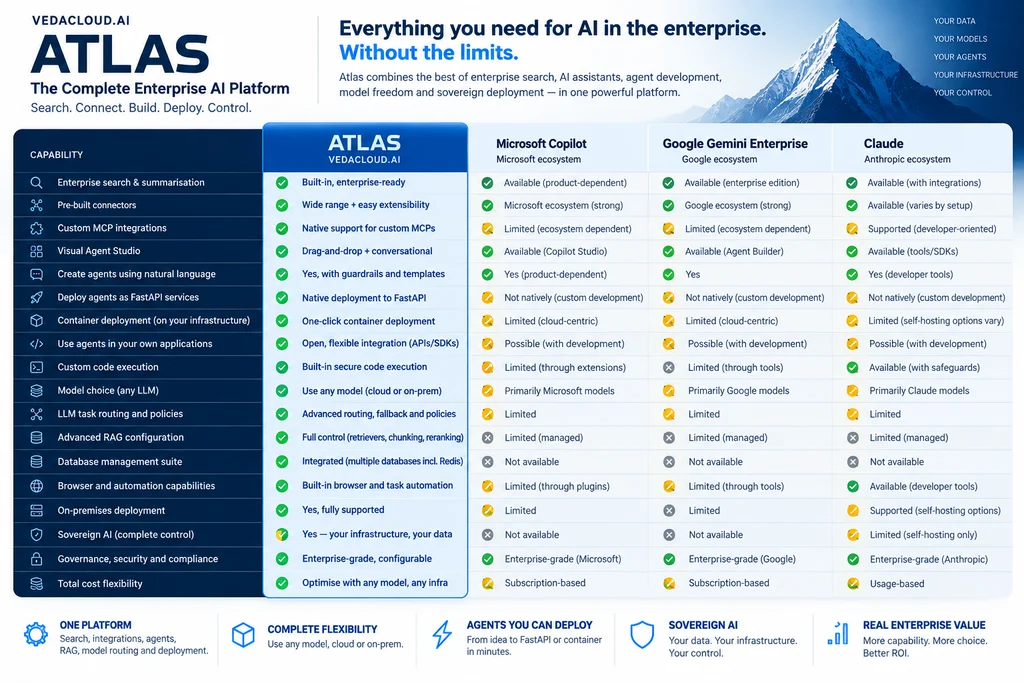
Enterprise AI is moving beyond the question of which assistant produces the best answer. Organizations increasingly need systems that can discover information across business applications, reason over internal knowledge, invoke tools, automate workflows, and deliver those capabilities inside the applications their teams already use.
Microsoft Copilot, Google Gemini Enterprise, and Claude are important reference points in this evolution. Their ecosystems provide enterprise assistance, integrations, and ways to build or extend AI-powered workflows.
But an enterprise architecture decision involves more than the assistant interface. It also involves model selection, retrieval configuration, tool connectivity, execution environments, deployment, and operational control.
Atlas by VedaCLOUD.AI takes a platform-oriented approach to this problem.
Atlas brings together enterprise search and summarization, built-in connectors, custom Model Context Protocol (MCP) integrations, visual and conversational agent creation, configurable retrieval and model routing, and options to deploy agents as services or containers.
Its central proposition is straightforward: give organizations a configurable AI platform in which they can build, connect, run, and integrate AI capabilities—with the ability to use cloud or on-premises models according to their requirements.
1. From AI assistance to a configurable AI platform
Search and summarization are important starting points. They help users locate relevant information and make sense of it.
However, enterprise workflows frequently require more. A support process might need to retrieve information from several systems, apply business rules, call an internal service, and return a structured result. A developer might want to build a specialized agent and expose it through an API. An enterprise architect might need to select different models for different tasks.
Atlas is designed to address these broader needs through a collection of configurable capabilities:
- Enterprise search and summarization.
- Built-in connectors and custom MCP integrations.
- Visual, drag-and-drop agent construction and natural-language agent creation.
- Configurable model selection and routing policies.
- Advanced retrieval-augmented generation (RAG) settings.
- User-created code execution capabilities.
- Agent deployment as FastAPI services or containers.
- Database and infrastructure management capabilities.
The engineering question is no longer simply whether an assistant can answer a question. It is how much control the organization has over the system that answers it—and what the organization can build around it.
2. Agent Studio: build agents for real workflows
Atlas Agent Studio is intended to make agent creation accessible through visual workflows and natural-language interaction.
This matters because enterprise agent development involves different audiences. Business teams may want to express a workflow in plain language. Technical teams may prefer to configure components, inspect execution paths, integrate APIs, and refine the underlying implementation.
A platform that supports both approaches can reduce the gap between a workflow idea and a working prototype.
The next step is deployment.
According to Atlas’s described capabilities, agents can be deployed as FastAPI services or containers. That opens a path for teams to incorporate agent functionality into their own applications and services rather than limiting its use to a single assistant interface.
For engineering teams, this changes the role of an agent builder: it becomes a potential part of the application development and integration toolchain.
Production adoption still requires the usual engineering disciplines—including authentication, authorization, secrets management, logging, resource limits, versioning, testing, and lifecycle management. Those controls should be documented for the specific Atlas deployment model.
3. MCP and connectors: connect AI to enterprise systems
An AI platform becomes more useful when it can work with the systems where business information and actions already live.
Atlas combines built-in connectors with support for custom MCP integrations, according to its product description. This gives teams a path to connect existing data sources and extend the platform with organization-specific tools.
MCP provides a standard way for AI applications to interact with external tools and resources. Custom MCP servers can help organizations integrate internal services that do not fit a generic connector catalogue.
The important engineering considerations are not merely the number of integrations. They include how credentials are handled, how user permissions are enforced, which tools can perform write operations, how actions are audited, and how failures are surfaced.
Connector breadth is not unique to Atlas—Microsoft and Google both document enterprise integration capabilities. The challenge for Atlas is to demonstrate how its built-in connectors, custom MCP support, and execution options fit together into a coherent and configurable workflow.
4. Model choice and routing: match the model to the task
Not every enterprise task has the same requirements.
A short classification task, a complex research request, a coding workflow, and a retrieval-heavy question may have different latency, cost, privacy, and quality constraints.
Atlas is described as supporting cloud and on-premises models, alongside configurable task assignments and LLM routing policies. This creates an opportunity to direct different workloads to different models according to an organization’s needs.
For example, an organization might choose one model for routine classification, another for complex reasoning, and an internally hosted model for selected workloads involving sensitive information.
That is an architectural pattern, not a guarantee of better results. The quality of the outcome depends on the models available, the routing rules, the evaluation process, and the workload itself.
A credible implementation should let administrators understand which model handled a request, why a route was selected, and how model behavior can be tested and improved.
5. Advanced RAG: retrieval is an engineering discipline
Retrieval-augmented generation is often described as a way to ground model responses in organizational information. In practice, its quality depends on multiple decisions: document processing, chunking, indexing, embeddings, metadata, retrieval strategy, ranking, context construction, and evaluation.
Atlas exposes advanced RAG configuration as part of its broader platform proposition.
That flexibility is relevant to organizations whose data does not fit one universal retrieval recipe. Different collections may require different indexing strategies, metadata filters, retrieval settings, or access controls.
The engineering challenge is to make that flexibility manageable. Configuration options should be accompanied by meaningful defaults, observability, repeatable evaluations, and a way to compare changes against representative enterprise questions.
The goal is not maximum configuration for its own sake. It is controlled, measurable improvement in retrieval quality and system behavior.
6. Deploy agents beyond the platform
A useful agent should not necessarily remain inside the interface where it was created.
Atlas’s described FastAPI and container deployment options are particularly relevant to application teams. A team could package an agent for use by another service, embed it in a product workflow, or deploy it in an environment aligned with its operational requirements.
These deployment forms also create practical questions that an engineering evaluation should answer:
- How are dependencies and runtime versions managed?
- How are credentials and environment-specific settings supplied?
- How are agent versions promoted between environments?
- What authentication and authorization protect deployed endpoints?
- How are logs, traces, errors, and resource consumption monitored?
- What are the scaling, isolation, and update procedures?
These details determine whether agent deployment is a useful demonstration or a dependable production capability.
7. Sovereign AI: control the deployment architecture
For some organizations, the location and control of AI workloads are fundamental architecture decisions.
Atlas is positioned around sovereign AI, with the stated ability to work with cloud or on-premises models. This can be relevant to enterprises that need to keep selected workloads within customer-controlled infrastructure or want greater control over the systems that process their information.
Sovereignty should be described precisely. It is not established by the presence of an on-premises model alone. The full design must account for data flows, model endpoints, logs, telemetry, backups, identity systems, external connectors, software dependencies, and administrative access.
A strong Atlas deployment guide should make these boundaries explicit: what can run locally, what may call an external service, what information leaves the environment, and which controls are available to administrators.
That is how a sovereignty-oriented architecture becomes assessable rather than merely aspirational.
8. Atlas and the alternatives: compare architectures, not slogans
Microsoft Copilot, Gemini Enterprise, and Claude each offer evolving capabilities for enterprise assistance and agent-driven workflows. Their precise features depend on product editions, integrations, and deployment choices.
Atlas should therefore be evaluated on the architecture it brings together and the control it exposes to customers—not on an unsupported claim that competitors lack agents, connectors, or custom development.
The practical comparison should ask:
- Can the organization use its preferred cloud and on-premises models in the configurations it needs?
- Can teams create agents visually or conversationally and deploy them as reusable services?
- How easily can built-in connectors and custom MCP integrations be combined?
- How much control is available over retrieval, task assignment, and model routing?
- What code execution options exist, and how are they isolated and governed?
- Which components can be operated in customer-controlled infrastructure?
- How are identity, access, auditing, monitoring, and lifecycle management implemented?
- Can the platform meet the organization’s requirements under repeatable tests?
These questions produce a more useful evaluation than a feature-count contest.
Conclusion: the platform is the product
The enterprise AI market is developing quickly. Assistants are becoming agent interfaces, and agent builders are becoming part of broader development platforms.
Atlas’s ambition is to bring search, connectors, MCP integrations, Agent Studio, model and retrieval configuration, code execution, deployable agents, and sovereignty-oriented deployment into one configurable environment.
For organizations that want to build AI workflows rather than simply consume an assistant, that is a proposition worth evaluating.
The challenge to the established platforms is not that they cannot build agents or connect to enterprise data. It is this:
Can Atlas offer the right combination of model freedom, integration flexibility, deployment choice, operational control, and sovereign architecture for the workloads your organization actually needs?
That question should be answered with architecture reviews, reproducible benchmarks, security assessments, and hands-on engineering trials—not slogans.
The next generation of enterprise AI will be shaped not just by the model a company chooses, but by the platform it can confidently build around it.
Was this article helpful?