
Freedom Fighters · Unsung Heroes
Rani Chennamma of Kittur
1778 – 1829
The queen of Kittur whose forces defeated the East India Company in 1824.
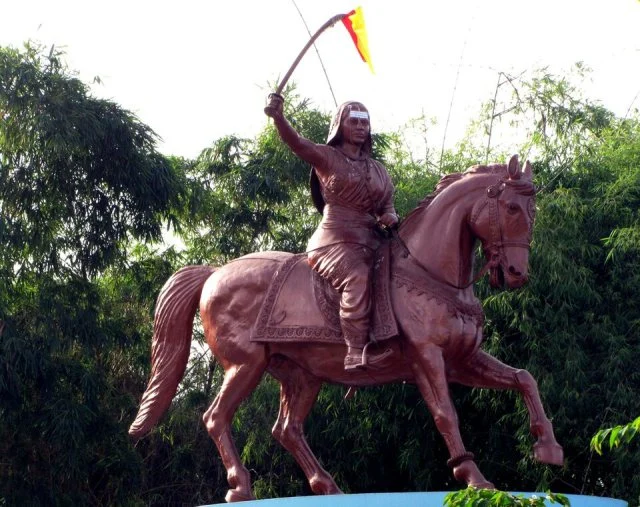
When the East India Company refused to recognise her adopted son as heir to Kittur, Rani Chennamma resisted. Her forces defeated a Company force in October 1824, killing the Collector, St John Thackeray. A larger Company force captured Kittur later that year, and she died in captivity in 1829.
Early life and background
Born in Kakati near Belagavi, Chennamma was trained in riding and arms. She married Raja Mallasarja of Kittur, a small principality in present-day Karnataka.
Historical context
After the deaths of her husband and then her son, Chennamma adopted Shivalingappa as heir. The East India Company refused to recognise the adoption and moved to take control of Kittur and its treasury — a policy later formalised as the Doctrine of Lapse.
Key achievements
In October 1824 Kittur’s forces resisted the Company’s attempt to take control; the Collector, St John Thackeray, was killed and Company officers were taken prisoner. A second, larger Company force besieged Kittur in December 1824 and captured the Rani.
Important events and milestones
- 1824 Company refuses to recognise her adopted heir.
- October 1824 Kittur forces defeat Company troops.
- December 1824 Kittur besieged; Chennamma captured.
- 21 February 1829 Dies in captivity at Bailhongal fort.
Awards and honours
Her statue was installed in the Parliament complex, New Delhi, in 2007. India Post issued a stamp in her honour in 1977.
Her sacrifice
Chennamma was imprisoned in Bailhongal fort, where she died on 21 February 1829. Her lieutenant Sangolli Rayanna continued the resistance until his capture and execution.
Enduring legacy
Rani Chennamma is one of the earliest rulers to take up arms against the Company’s annexation policies and is a celebrated figure in Karnataka.
References
Portrait: Statue of Rani Chennamma (photograph) · Suma · CC BY-SA 2.0 · Source (opens in a new tab) · Licence terms (opens in a new tab)
This account is compiled from the sources listed and is offered as a tribute, not as an official record. Corrections are welcome at connect@vedacloud.ai.