
VedaCLOUD.AI’s ATLAS: Enterprise AI Infrastructure for Secure Knowledge, Governed Agents and Intelligent Automation
On this page
- 1. Overview
- 2. Enterprise AI architecture
- Core architectural components
- 3. Enterprise data acquisition and intelligent document processing
- 4. Hybrid search, RAG and grounded knowledge assistance
- 5. Knowledge graphs and relationship intelligence
- 6. Model orchestration and model lifecycle management
- 7. Agent development, orchestration and tool execution
- Agent Studio
- Controlled agent execution
- 8. Reusable enterprise AI capabilities
- Intelligent document processing
- Content generation and summarisation
- Conversational AI
- Enterprise integration
- 9. Security architecture and identity management
- Identity and access management
- Permission-aware information access
- Secrets management
- 10. AI privacy, guardrails and responsible execution
- 11. AI governance and lifecycle controls
- 12. AI evaluation and quality assurance
- 13. Observability, operational management and FinOps
- Operational observability
- Cost and resource controls
- Operational support
- 14. Deployment flexibility and infrastructure
- Data persistence and recovery
- Infrastructure security
- 15. Enterprise integration and interoperability
- 16. Business applications
- 17. Technical foundation at a glance
- 18. Conclusion
An enterprise AI platform combining retrieval-augmented generation, knowledge graphs, model orchestration, document intelligence and agentic workflows in a modular, deployment-flexible architecture.
Product: ATLAS
Organization: VedaCLOUD.AI
Website: https://www.vedacloud.ai
1. Overview
VedaCLOUD.AI’s ATLAS is an enterprise AI platform designed to transform organizational information into searchable knowledge, contextual intelligence and AI-assisted business workflows.
ATLAS combines enterprise search, retrieval-augmented generation (RAG), document intelligence, knowledge graphs, language-model orchestration and agent development capabilities within a modular application architecture. It enables organisations to build AI-powered knowledge assistants, automate document-centric processes, connect approved enterprise systems and develop workflows that combine AI reasoning with structured tools and business logic.
The platform is designed to support enterprise deployment requirements across data management, model selection, identity and access control, workflow governance, evaluation, monitoring and operational management.
ATLAS follows a reusable-capability approach: common AI services can support multiple business applications, reducing the need to build a separate technology stack for each use case. The resulting architecture can be adapted to internal knowledge management, customer and employee assistance, document processing, research, investigation support and controlled business automation.
2. Enterprise AI architecture
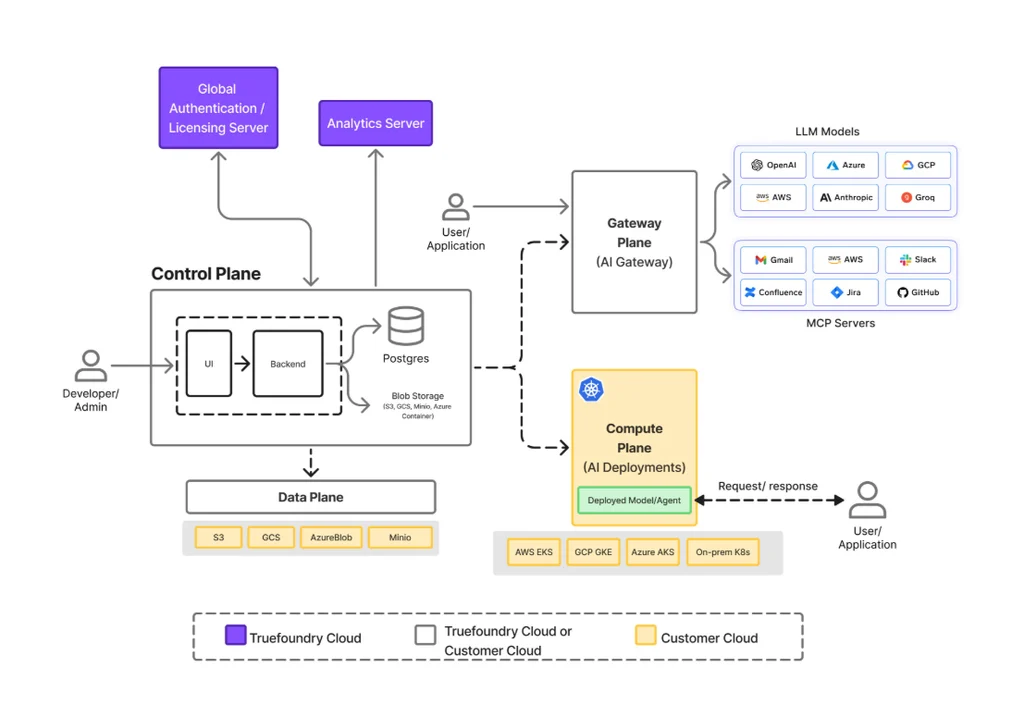
ATLAS is implemented as a modular, containerised platform with specialised services for identity, data ingestion, retrieval, AI execution, administration and operations.
Its architecture separates business-facing functionality from underlying data services, model integrations and execution infrastructure.
Core architectural components
| Component | Technical responsibility |
|---|---|
| API gateway | Central application entry point, request routing, authentication enforcement, rate limiting and request-level controls |
| Identity and access services | User authentication, role-based permissions, session management and administrative access |
| Data ingestion and document services | File acquisition, text extraction, OCR, document processing and metadata management |
| Retrieval and RAG engine | Query processing, hybrid retrieval, context construction and source-aware answer generation |
| Embedding and search services | Semantic representations, vector retrieval and keyword-based search |
| Knowledge graph services | Entity and relationship extraction, graph storage and relationship traversal |
| LLM routing and model management | Configured model endpoints, provider selection, usage controls and model lifecycle functions |
| Agent and workflow services | Workflow execution, tool invocation, conditional logic and agent lifecycle management |
| Monitoring and feedback services | Service health, operational metrics and feedback collection |
| Administration and licensing services | Platform configuration, management functions and licensing controls |
The reference implementation uses Go, Python and TypeScript application services, with PostgreSQL, Redis, MinIO, Weaviate and Memgraph as supporting infrastructure components.
PostgreSQL provides core relational storage; MinIO supports object storage; Redis provides caching, session and queue-related functions; Weaviate supports vector and keyword retrieval; and Memgraph provides graph-oriented processing.
This separation enables the platform to evolve individual services while retaining shared application, data and governance foundations.
3. Enterprise data acquisition and intelligent document processing
ATLAS provides document-ingestion capabilities for building enterprise knowledge collections from structured and unstructured information.
Supported document and content formats include PDF, Microsoft Office documents, HTML, Markdown, text, CSV, images and email formats. The documented processing pipeline includes text extraction, layout-aware processing, OCR, chunking, metadata association, embedding generation and index creation.
OCR capabilities include automatic script detection and support for English, Hindi and additional Indian scripts.
Extracted content can retain source metadata, including document, page and paragraph information, enabling downstream search and answer workflows to identify the material from which a response was generated.
The ingestion pipeline supports:
- Document upload and configured source ingestion.
- Text extraction and OCR for scanned documents.
- Content segmentation and metadata enrichment.
- Embedding generation and index management.
- Optional entity and relationship extraction.
- Knowledge-source updates and re-indexing workflows.
These capabilities provide a foundation for document discovery, policy assistance, research, structured extraction and knowledge-intensive business processes.
For production document processing, accuracy depends on document quality, extraction configuration, language, layout complexity and the validation rules applied to each business use case.
4. Hybrid search, RAG and grounded knowledge assistance
ATLAS combines lexical retrieval with semantic search to retrieve relevant enterprise information using both exact terms and natural-language queries.
Its RAG pipeline retrieves relevant passages, constructs model context and generates responses using the selected language model. Responses can include source references identifying relevant documents and their locations.
The platform also documents permission-aware retrieval controls, including access checks applied to documents and related knowledge-graph queries.
Key capabilities include:
- Semantic and keyword-based information retrieval.
- Configurable retrieval and context construction.
- Source-aware answer generation.
- Document-level access filtering.
- Knowledge-grounded conversational assistance.
- Optional external web research when enabled.
- Evaluation of retrieval relevance and answer grounding.
RAG can help reduce unsupported responses by grounding generation in retrieved evidence, but it does not guarantee factual correctness. Source quality, retrieval coverage, model behaviour and evaluation results remain important determinants of answer reliability.
For regulated information, source freshness, authoritative-document management and access permissions should be validated as part of deployment acceptance.
5. Knowledge graphs and relationship intelligence
ATLAS supports knowledge-graph capabilities that represent relationships between entities extracted from enterprise documents.
Graph-based processing complements document retrieval by enabling relationship discovery, entity exploration and multi-hop traversal across connected information.
The documented architecture uses PostgreSQL as the system of record for graph data and Memgraph for graph-oriented operations. Source provenance can be associated with extracted entities and relationships.
Applications include:
- Relationship discovery across documents.
- Connected-entity research.
- Context enrichment for RAG workflows.
- Investigation and due-diligence assistance.
- Discovery of information distributed across multiple sources.
The quality of graph-derived insights depends on entity extraction accuracy, relationship validation, source coverage and the freshness of the underlying knowledge.
6. Model orchestration and model lifecycle management
ATLAS provides a model-routing layer designed to support multiple configured AI model endpoints.
The documented integrations include local model runtimes such as Ollama, vLLM and LM Studio, alongside configured external providers such as OpenAI, Azure OpenAI, Google, Anthropic and Hugging Face.
Routing policies can consider configurable factors including priority, latency, cost, quality, load and failover behaviour. Model-specific usage limits can also be configured.
The platform’s model-management capabilities support the administration of model configurations and their use across AI workflows.
This architecture offers flexibility to select models for different tasks, including summarisation, retrieval-based question answering, structured extraction and agent execution.
Model selection and routing should be governed by task requirements, evaluation results, operating cost, privacy obligations and deployment constraints.
The actual location of inference and associated processing depends on the selected endpoint and deployment configuration. Local hosting, external model APIs and hybrid arrangements have different data-handling characteristics and should be assessed accordingly.
7. Agent development, orchestration and tool execution
ATLAS includes an agent development environment for creating workflows that combine model calls, retrieval, conditional logic, structured outputs and approved tools.
Agent Studio
The documented Agent Studio supports natural-language-assisted agent creation and a visual workflow editor.
Workflow components include language-model steps, knowledge retrieval, knowledge-graph queries, conditional branches, variables, templates, configured HTTP integrations, MCP tools, sandboxed Python execution and calls to other agents.
Saved workflows can be deployed as integrated agents or in dedicated execution containers. Version history, rollback and step-level debugging support development and troubleshooting.
Controlled agent execution
The agent architecture documents controls for user-permission-aware execution, configured step and time limits, isolated execution containers for code and tool execution, and restrictions on internal-address access through HTTP workflow blocks.
Agent visibility can be configured for private use, departmental access, named users or broader sharing, subject to configured permissions.
These capabilities provide the foundation for workflows that retrieve information, prepare recommendations, interact with approved tools and execute defined process steps.
The authorisation of external actions remains a separate control requirement. Financial transactions, customer-impacting changes and other high-risk operations should use explicit confirmation, appropriate approval workflows and independently enforced permissions.
8. Reusable enterprise AI capabilities
ATLAS provides common technical capabilities that can be composed into multiple applications rather than replicated independently for each business function.
Intelligent document processing
OCR, document classification, structured extraction, configured validation and human review can support document-centric workflows. Examples include extracting information from application forms, checking document completeness and preparing structured information for downstream systems.
Content generation and summarisation
The platform documents cited summaries, research notebooks, structured outputs and configurable content-generation workflows. These can support research briefs, internal knowledge summaries and document preparation.
Conversational AI
Conversational workflows can combine natural-language interaction with enterprise retrieval and configured tools. Voice-related components provide options for speech input and output, including offline processing configurations.
Enterprise integration
ATLAS exposes application APIs and supports configured integrations through connectors and MCP tools. Its documented architecture includes file-source and database integrations, scheduled ingestion and connected-system interactions.
The readiness of each integration depends on the configured connector, authentication method, required permissions and target system. Production deployment should validate synchronisation, error handling, credential security and auditability for every connected source.
9. Security architecture and identity management
Security controls are integrated into the documented ATLAS architecture across application access, retrieval, agent execution and administration.
Identity and access management
ATLAS includes authentication and role-based access control, with documented options for single sign-on integrations, directory synchronisation and configurable multi-factor authentication policies.
The API gateway is designed to enforce authentication and route-level permissions. The documented request flow removes client-supplied identity headers before establishing verified identity context for downstream services.
Deployment-specific validation should cover identity-provider integration, privileged access, session revocation, service identities and separation of administrative responsibilities.
Permission-aware information access
Access checks are documented for knowledge retrieval, document ownership and shared-agent execution.
In enterprise environments, these controls must remain consistent across search, graph traversal, APIs, cached results, notebooks, integrations and agent workflows so that information is exposed only to authorised users and services.
Secrets management
ATLAS documents encrypted storage for configured provider credentials and an encrypted secrets vault, with optional HashiCorp Vault integration.
Credentials and tokens for model providers, databases and connected systems should be managed through approved secrets-handling processes. Their exposure through prompts, client payloads, logs and deployment artefacts should be tested and prevented.
10. AI privacy, guardrails and responsible execution
ATLAS documents configurable controls intended to reduce sensitive-data exposure and mitigate AI-specific threats.
These include PII masking, prompt and output safety controls, prompt-injection and jailbreak detection capabilities, and restrictions on agent tool access.
The platform also documents source-grounding and answer-verification functions for retrieval-based workflows.
These controls are intended to operate alongside identity enforcement, workflow authorisation and human oversight rather than replace them.
A responsible enterprise AI implementation should include:
- Input and output validation.
- Sensitive-data detection and appropriate masking or blocking.
- Retrieval filtering based on user permissions.
- Restrictions on agent access to tools and data.
- Human approval for designated high-risk actions.
- Evaluation against adversarial and failure scenarios.
- Versioned configuration and controlled deployment changes.
- Monitoring and review of safety incidents and exceptions.
The effectiveness of these controls depends on configuration, model behaviour, the execution path and the results of security testing. They should be validated against representative and adversarial test cases before being relied on for high-impact workloads.
11. AI governance and lifecycle controls
ATLAS documents management functions for models, prompts, agents, configurations and workflow versions, alongside debugging, evaluation and rollback capabilities.
These functions support controlled development and operational change management.
A governed AI lifecycle should include intake and classification, testing, approval, deployment, monitoring, periodic reassessment and retirement. Model and agent changes should be evaluated for their effect on quality, safety, access permissions and business outcomes.
The platform’s documented evaluation functions include datasets, retrieval-quality measures, factual-grounding checks, regression testing and model comparisons.
For enterprise adoption, each production workflow should have defined owners, approved versions, documented limitations, acceptance criteria and an appropriate rollback or disablement procedure.
12. AI evaluation and quality assurance
ATLAS provides evaluation capabilities intended to assess the quality of retrieval and generated responses.
Evaluation can be structured around three levels.
| Evaluation level | Example measures |
|---|---|
| Model | Accuracy, response quality, safety, latency and cost |
| Retrieval and RAG | Relevance, source coverage, groundedness, citation quality and retrieval latency |
| Agent workflow | Task completion, tool selection, policy adherence, exception handling and execution efficiency |
Evaluation should use representative datasets and business scenarios, with documented thresholds and regression tests.
Production acceptance should also examine failure handling, human escalation, incorrect or incomplete information, access-control violations and the consequences of an unsuccessful tool invocation.
An evaluation framework supports measurable quality assurance; actual performance must be established through recorded test results.
13. Observability, operational management and FinOps
ATLAS includes monitoring and administration services intended to provide visibility into application health and selected operational activity.
The documented implementation includes service health checks, operational metrics, gateway audit logging, workflow run history and administrative diagnostics.
These functions provide a basis for investigating service failures, reviewing configured workflows and monitoring application behaviour.
Operational observability
Enterprise operations should correlate application events, model calls, retrieval activity, tool execution, errors and infrastructure metrics to support incident investigation and service management.
The exact coverage of traces, audit records, alerting and external monitoring integrations depends on the deployed configuration.
Cost and resource controls
The model-routing layer supports cost-aware routing criteria and configurable model usage limits.
These capabilities can help teams control model consumption and compare configured execution options. Broader requirements—such as detailed cost allocation, forecasting, chargeback, budget enforcement and executive FinOps reporting—should be implemented and validated where required by the operating model.
Operational support
ATLAS’s deployment and troubleshooting documentation covers installation, service status, logs, upgrades, backups, restoration and re-indexing.
A production operating model should establish incident priorities, escalation procedures, patch management, change control, support responsibilities and service-level commitments.
14. Deployment flexibility and infrastructure
ATLAS documents a container-based deployment approach using Docker Compose on Linux hosts.
Its deployment options include CPU-only execution, optional NVIDIA GPU acceleration, local-model integrations and hybrid configurations using external AI providers.
An air-gapped deployment mode is documented for configurations in which live web search and outbound chat calls are disabled, with offline execution networks available for sandboxed code.
This flexibility allows deployment architecture to be aligned with infrastructure constraints, processing requirements and organisational data policies.
Data persistence and recovery
The reference deployment uses persistent storage for application databases, document objects, vector indexes, graph data and supporting services.
The backup documentation describes protecting core database records, uploaded files and configuration. Vector indexes can be rebuilt from source data, and the knowledge graph can be resynchronised from its system of record.
Production resilience requires additional architecture and operational evidence appropriate to the environment, including replication, recovery objectives, secondary infrastructure and tested restoration procedures.
Infrastructure security
Network exposure, TLS termination, encryption settings, host hardening, service isolation and secrets handling must be configured and reviewed for the actual deployment.
The availability of a containerised deployment option does not by itself establish a particular uptime commitment, recovery objective or certification status.
15. Enterprise integration and interoperability
ATLAS provides APIs, configured connectors and MCP-based tool integration to connect AI workflows with approved data sources and applications.
The platform’s modular architecture is designed to support the addition of integrations and the composition of shared services into new workflows.
Integration patterns should be selected according to the target system’s supported APIs, authentication model, event capabilities and data-access requirements.
A production integration should document:
- Authentication and authorisation.
- Data ownership and access boundaries.
- API contracts and versioning.
- Synchronisation and data freshness.
- Rate limits and failure recovery.
- Credential lifecycle management.
- Audit records and operational monitoring.
The readiness and compatibility of a specific integration should be established through testing against the actual target environment.
16. Business applications
ATLAS’s common capabilities can support a range of enterprise applications.
| Application area | Potential implementation |
|---|---|
| Enterprise knowledge assistant | Search and answer questions over approved internal documents with source references |
| Personal finance assistance | Retrieve approved financial information and support conversational guidance, subject to business rules |
| Account-opening assistance | Organise application information, extract documents and coordinate configured workflow steps |
| Property and lending research | Retrieve relevant records, extract evidence and support relationship analysis |
| Lead management assistance | Enrich authorised information, prepare summaries and support configured follow-up workflows |
| Grievance handling | Classify incoming complaints, summarise case history and assist routing and resolution |
| Financial-crime investigation support | Retrieve approved records, explore entity relationships and prepare structured investigation summaries |
| Employee productivity | Summarise policies, compare documents, prepare research and locate internal knowledge |
These applications are built by combining shared retrieval, document-processing, conversational, model and agent capabilities with business-specific data, integrations and policies.
Their production suitability depends on the applicable business requirements, system integration, validation results, human oversight and approval arrangements.
17. Technical foundation at a glance
| Category | ATLAS technical foundation |
|---|---|
| Application architecture | Modular containerised services |
| Application technologies | Go, Python and TypeScript |
| Relational storage | PostgreSQL |
| Object storage | MinIO |
| Vector and keyword retrieval | Weaviate |
| Knowledge graphs | Memgraph, with PostgreSQL as the documented system of record |
| Caching and queues | Redis |
| Knowledge processing | Document extraction, OCR, chunking and embeddings |
| Retrieval | Hybrid search and RAG |
| Model access | Configured local and external model endpoints |
| Agent development | Visual workflows, conditional logic, tools and MCP integrations |
| Access control | Authentication, roles and permission-aware retrieval |
| AI safety | Configurable PII and prompt/output safety controls |
| Evaluation | Retrieval and response-quality evaluation functions |
| Deployment | Docker Compose, Linux and configurable local or hybrid model deployments |
| Operational management | Health checks, logs, metrics, backup and restore procedures |
18. Conclusion
VedaCLOUD ATLAS brings together enterprise knowledge retrieval, document intelligence, graph-based relationship analysis, configurable model orchestration and agentic workflow development in a reusable AI platform.
Its modular architecture provides a common foundation for knowledge-intensive applications and controlled automation, while documented identity, access, privacy, evaluation and operational capabilities support enterprise deployment planning.
The platform is designed to be configured around organisational data boundaries, approved models, connected systems and business workflows. Effective enterprise deployment requires these capabilities to be validated in the selected environment, supported by documented controls, measurable acceptance criteria and an appropriate operating model.
VedaCLOUD ATLAS: Turning enterprise information into governed, actionable intelligence.
For product and enterprise deployment enquiries, visit https://www.vedacloud.ai or contact connect@vedacloud.ai.
Downloads
- ATLAS — Technical & Customer Deck
ATLAS technical and customer briefing (PowerPoint, 10 slides).