
Release notes · VedaAnalytics
VedaAnalytics: A Unified Self-Hosted Platform for Data, AI and Analytics
PRODUCT RELEASE NOTES
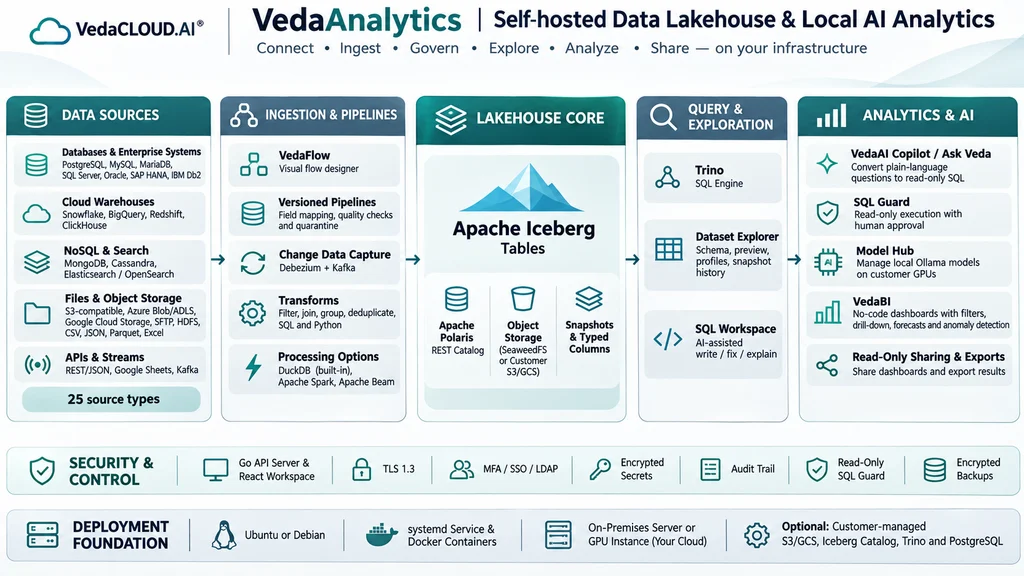
VedaCLOUD.AI introduces VedaAnalytics, a self-hosted enterprise data and analytics platform that brings data integration, visual pipeline engineering, change data capture, an open lakehouse, SQL exploration, AI-assisted analytics, business intelligence and machine learning together in one environment.
Designed for organisations that want to make more of their data while retaining control over infrastructure, storage, identity and AI execution, VedaAnalytics brings visual and code-oriented workflows into a shared workspace. Business users can explore information and ask questions in natural language, while data and platform teams can build pipelines, work with SQL and Python, manage models and operate the platform.
Release highlights
- Connect enterprise databases, analytical platforms, files, object stores, APIs, NoSQL systems and event sources.
- Build visual pipelines, capture supported database changes and process events with VedaFlow.
- Query an open lakehouse built on Apache Iceberg, Apache Polaris and Trino.
- Use VedaAI and Model Hub for conversational analytics, AI-assisted development and local model operations.
- Explore dashboards, machine learning, document intelligence and advanced analytics in one connected environment.
1. A unified, self-hosted data and analytics workspace
VedaAnalytics is built around a self-hosted deployment model. Organisations can choose where application services, compute, object storage, catalog services, query engines and AI runtimes operate. This provides an integrated environment for connecting source systems, preparing data, querying curated datasets, building dashboards and applying AI-assisted analysis.
The platform brings together data, model and control-plane capabilities while supporting both guided visual experiences and technical workflows. Teams can start with a data connection or a business question, then move through ingestion, transformation, analysis and operational use without treating each stage as a separate product.
2. Broad enterprise data connectivity
VedaAnalytics provides managed connections across a broad range of enterprise data systems and formats. Connection workflows cover endpoint configuration, authentication, connectivity testing, object discovery, preview and reuse in downstream workflows.
- Relational databases: PostgreSQL, MySQL, MariaDB, Microsoft SQL Server, Oracle, SAP HANA and IBM Db2 LUW.
- Analytical platforms: Snowflake, Google BigQuery, Amazon Redshift and ClickHouse.
- NoSQL and search: MongoDB, Cassandra, Elasticsearch and OpenSearch.
- Object and file storage: S3-compatible storage, Azure Blob Storage / ADLS Gen2, Google Cloud Storage, SFTP, FTP, FTPS, HDFS, WebHDFS and server-mounted folders.
- APIs and productivity data: REST/JSON APIs and Google Sheets; event integration through Apache Kafka.
- File formats: CSV, TSV, JSON, JSON Lines, Parquet and Excel.
3. VedaFlow: visual data pipeline engineering
VedaFlow provides a visual canvas for building source-to-destination data workflows. Users can add source, transformation and destination nodes, connect them into a directed flow, configure each step and inspect the workflow before execution.
Flows support validation, sample-data previews, versioning, publishing and execution manually, on a schedule or continuously for supported event sources. Transformation options include column selection and renaming, type conversion, filtering, joins, grouping and aggregation, de-duplication, unions, SQL and Python.
Execution profiles include DuckDB, Apache Spark and Apache Beam. CPU, memory, timeout and supported runtime resource settings can be configured to align execution with the target environment.
4. Change data capture and event streaming
For supported source systems, VedaAnalytics provides change data capture (CDC) workflows that combine an initial snapshot with ongoing capture of database changes. Replication can be organised in Mirror mode, which maintains a current representation of source data, or History mode, which preserves change history for downstream analysis.
Kafka-based event workflows and supported HTTP ingestion patterns extend the platform beyond scheduled batch loads. Event processing can be connected to VedaFlow and written into lakehouse destinations, with operational monitoring for source capture, event lag, processing status and destination application.
5. Open lakehouse foundation
VedaAnalytics uses Apache Iceberg tables on object storage as its lakehouse foundation, Apache Polaris as the Iceberg REST catalog layer and Trino for SQL query access. This open architecture is designed to keep analytical data in interoperable table formats while separating storage, catalog and query services.
The lakehouse workflow includes dataset and table organisation, schema-aware table access, snapshot metadata and time-travel capabilities. It provides a shared analytical foundation for SQL exploration, dashboards, AI-assisted analysis and downstream data-science workflows.
6. Explorer, SQL workspace and AI-assisted analytics
The Explorer and SQL workspace let users browse datasets, inspect schemas, view table profiles, understand relationships through dataset diagrams and work directly with SQL. Query results can be reviewed and exported through the analytical workspace.
VedaAI adds a natural-language interface to analytical work. Users can ask questions about selected datasets and receive SQL grounded in available schemas and metadata. The workflow includes query validation, safety checks, explainability and a human review step before execution. VedaAI can also assist with writing, fixing, explaining and improving SQL and supported flow code.
7. Model Hub: local AI and GPU orchestration
Model Hub provides a central interface for managing local AI model operations. It supports model discovery and download through configured Ollama runtimes, deployment management, CPU or GPU placement, replica configuration and task-based model routing.
Administrators can review runtime health and available compute resources, including GPU visibility and memory capacity, and manage model availability for the platform’s AI workloads. This helps organisations align model execution with their infrastructure and data-locality requirements.
8. VedaBI: dashboards and visual analytics
VedaBI provides a visual business intelligence layer for turning curated datasets into charts and dashboards. The chart builder supports a library of 11 chart types, with configurable dimensions, measures, aggregations, filters, sorting and display options.
Dashboards support movable and resizable tiles, shared filters, click-to-filter interactions, time drill-down, refresh settings and full-screen viewing. VedaBI can propose an initial dashboard from a table profile, helping teams move from a newly prepared dataset to an initial analytical view.
Analytical features include time-series forecasting, unusual-point detection and plain-language findings based on chart results. Dashboard content can be exported in CSV, TSV, Excel, Parquet and JSON Lines formats. Read-only sharing and iframe embedding support approved downstream consumption.
9. Semantic catalog, lineage and data quality
VedaAnalytics includes a semantic and governance layer for describing data in business terms. Teams can define glossary terms, semantic entities and relationships, reusable measures and governed metrics, alongside technical metadata about datasets and tables.
Lineage and impact analysis help users understand how data products are connected and what may be affected by a change. Data quality rules can address completeness, uniqueness, validity, consistency, referential integrity, timeliness and accuracy, with configurable outcomes such as warning, quarantine or stopping a workflow.
10. VedaML: feature engineering and MLOps
VedaML connects curated lakehouse data to machine-learning workflows. Its documented lifecycle spans feature engineering, feature validation, feature-store management, experiment tracking, model training and evaluation, model registration, serving and monitoring.
Feature definitions can retain their types, transformation logic, source lineage, ownership and freshness expectations. Offline and online feature-store patterns support historical training and serving use cases, while point-in-time correctness practices help reduce training-data leakage. Model lifecycle stages and monitoring cover evaluation, deployment, prediction quality and drift signals.
11. Document intelligence, retrieval and agentic analytics
VedaAI extends analytical workflows to unstructured information through document ingestion, parsing and extraction, OCR for scanned content, structured metadata, chunking, embeddings and vector indexing. Hybrid retrieval can combine keyword and semantic search, with reranking to identify relevant source material.
Retrieval-Augmented Generation (RAG) supports answers grounded in retrieved documents and source references. Access-aware retrieval is designed to preserve source permissions. Agentic analytics coordinates bounded tools—such as dataset search, profiling, SQL, statistics, document search, Python, dashboards and report generation—within a planned and reviewable workflow.
12. Advanced analytics: statistics, graph and geospatial
The platform’s advanced analytics scope brings together exploratory statistics, statistical inference, experimentation and A/B testing, causal-analysis methods, forecasting, anomaly and change detection, graph analytics and geospatial processing. Scenario analysis and optimisation support decision workflows that must consider objectives, constraints and assumptions.
Analytical outputs are intended to be interpreted with their data, parameters, diagnostics and limitations. For example, an anomaly is an investigation signal rather than proof of a cause, and a forecast is an estimate rather than a guarantee.
13. VedaGateway: API, event and IoT ingestion
VedaGateway provides an ingestion architecture for application events, partner APIs, webhooks, device telemetry and industrial or IoT data. Its integration model covers producer identity, payload validation, schema management, routing, buffering and event transport into downstream workflows.
Protocol families addressed by the gateway architecture include HTTP/REST, webhooks, WebSockets, gRPC, MQTT, AMQP, Kafka protocol, OPC UA, Modbus TCP/RTU and CoAP. The specific adapters available depend on the deployed gateway components and release configuration.
14. Identity, security and enterprise governance
VedaAnalytics includes enterprise identity and security capabilities for self-hosted deployments. Documented identity options include local accounts, TOTP multi-factor authentication, OpenID Connect, SAML 2.0, LDAP / Active Directory and SCIM-based user and group provisioning.
Transport and service protections include configured TLS 1.3, internal certificate authority workflows and mutual TLS for model runtimes. The platform’s governance approach brings together role-based administration, secure connection credentials, auditability, data classification, retention practices and policy-aware access across analytical workflows.
15. Deployment, monitoring and operations
VedaAnalytics is designed for deployment profiles spanning development, pilot and production environments, including disconnected or air-gapped scenarios where the required services and artefacts are made available within the environment. Components can be placed according to organisational requirements for application services, databases, object storage, catalogs, query engines, event transport, flow execution and model serving.
Operational guidance covers service health, infrastructure and application monitoring, connection and pipeline status, CDC lag, query performance, lakehouse metadata, model runtime health, security events, backup scope, restore procedures and resilience planning. High availability, disaster recovery and scaling are addressed through component-level architecture and deployment design.
Release compatibility note. Connector versions, protocol adapters, model requirements, execution engines and deployment topology are environment- and release-dependent. Confirm the compatibility matrix and deployment prerequisites for the exact VedaAnalytics release before production rollout.
Getting started with VedaAnalytics
To learn more about the platform, explore the VedaAnalytics product page and technical documentation, or contact VedaCLOUD.AI to discuss your deployment requirements.
Product page: vedacloud.ai/products/vedaanalytics/
Contact: connect@vedacloud.ai