
Freedom Fighters · Revolutionaries
Chandrashekhar Azad
1906 – 1931
The revolutionary who called himself ‘Azad’ — free — and kept that promise to the end.
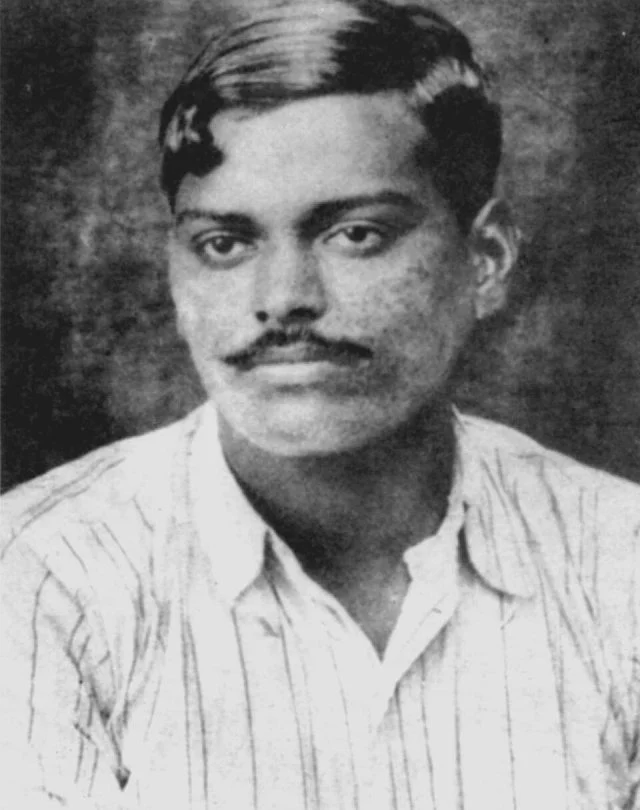
Chandrashekhar Azad was a leading organiser of the Hindustan Republican Association and its successor, the Hindustan Socialist Republican Association. He took part in the Kakori train action of 1925 and the 1928 Lahore action, and evaded capture for years until he was surrounded by police in Allahabad in February 1931.
Early life and background
Born in Bhavra in central India, Chandrashekhar Tiwari studied Sanskrit in Varanasi. As a teenager he joined the Non-cooperation Movement in 1921 and was arrested. According to the widely recorded account, when brought before a magistrate he gave his name as ‘Azad’ (free), the name by which he was known thereafter.
Historical context
After the Non-cooperation Movement was called off in 1922, some young nationalists turned to revolutionary organisation. Azad joined the Hindustan Republican Association led by Ram Prasad Bismil.
Key achievements
Azad took part in the Kakori train action of 9 August 1925, in which revolutionaries seized government money being carried by train. When most of the group were arrested, he escaped and rebuilt the organisation, which in 1928 became the Hindustan Socialist Republican Association with Bhagat Singh, Sukhdev and others. He was involved in the December 1928 Lahore action in which police officer John Saunders was killed, and continued to organise underground for the movement.
Important events and milestones
- 1921 Arrested as a teenager during the Non-cooperation Movement.
- 9 August 1925 Takes part in the Kakori train action.
- 1928 Helps form the Hindustan Socialist Republican Association.
- 17 December 1928 Takes part in the Lahore action against John Saunders.
- 27 February 1931 Dies in Alfred Park, Allahabad, after being surrounded by police.
Awards and honours
Alfred Park in Prayagraj was renamed Chandrashekhar Azad Park. His birthplace in Madhya Pradesh is now known as Chandrashekhar Azad Nagar.
His sacrifice
On 27 February 1931 Azad was surrounded by police in Alfred Park, Allahabad. He exchanged fire, and by the most widely accepted account used his last bullet on himself rather than be captured. He was twenty-four.
Enduring legacy
Azad’s refusal to be taken alive, and his work holding together a revolutionary movement under intense pressure, made him one of the best-remembered revolutionaries of the freedom struggle.
References
- Encyclopaedia Britannica — Chandra Shekhar Azad (opens in a new tab)
- Wikipedia — Chandra Shekhar Azad (with cited sources) (opens in a new tab)
Portrait: Photograph · Unknown · CC BY-SA 4.0 · Source (opens in a new tab) · Licence terms (opens in a new tab)
This account is compiled from the sources listed and is offered as a tribute, not as an official record. Corrections are welcome at connect@vedacloud.ai.