
Freedom Fighters · Revolutionaries
Shaheed Bhagat Singh
1907 – 1931
A revolutionary thinker who gave his life at twenty-three and whose ideas outlived the gallows.
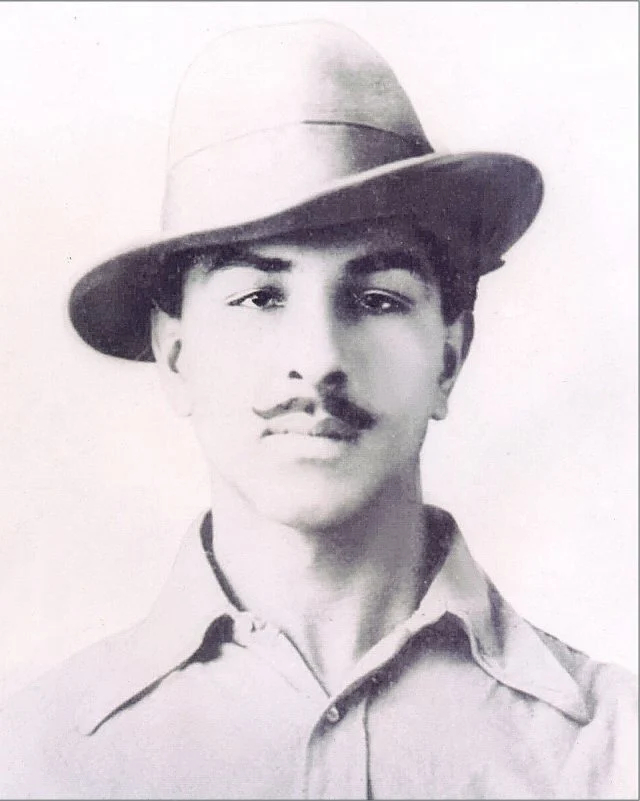
A leading member of the Hindustan Socialist Republican Association, Bhagat Singh took part in the 1928 Lahore shooting of police officer John Saunders and, with Batukeshwar Dutt, threw non-lethal bombs into the Central Legislative Assembly in 1929 and courted arrest. He was hanged in Lahore on 23 March 1931 with Rajguru and Sukhdev.
Early life and background
Bhagat Singh was born into a family already active in the national movement; his father and uncles had been involved in anti-colonial agitation. He studied at the National College in Lahore, where he read widely in history, politics and literature. The Jallianwala Bagh massacre of 1919 is recorded as having made a deep impression on him as a boy.
Historical context
In the 1920s, a generation of young revolutionaries in northern India believed that organised armed action, together with political education, could awaken the country. Bhagat Singh helped found the Naujawan Bharat Sabha in 1926 and, in 1928, helped reorganise the Hindustan Republican Association as the Hindustan Socialist Republican Association (HSRA).
Key achievements
After Lala Lajpat Rai died in 1928 following a police lathi charge on a protest against the Simon Commission, Bhagat Singh, Rajguru and Chandrashekhar Azad took part in an action intended to avenge him, in which Assistant Superintendent of Police John Saunders was shot dead in Lahore on 17 December 1928. On 8 April 1929 Bhagat Singh and Batukeshwar Dutt threw bombs, designed not to kill, into the Central Legislative Assembly in Delhi, scattered leaflets and allowed themselves to be arrested so that their trial could become a platform for their ideas. In prison he led a long hunger strike demanding decent treatment for political prisoners.
Important events and milestones
- 1926 Helps found the Naujawan Bharat Sabha.
- 1928 HSRA formed; Saunders shot in Lahore on 17 December.
- 8 April 1929 Central Legislative Assembly protest with Batukeshwar Dutt; both court arrest.
- 1929 Hunger strike in jail for the rights of political prisoners.
- 7 October 1930 Sentenced to death in the Lahore Conspiracy Case by a special tribunal.
- 23 March 1931 Executed in Lahore Central Jail with Rajguru and Sukhdev.
Awards and honours
23 March is observed across India as Shaheed Diwas (Martyrs’ Day) in memory of Bhagat Singh, Rajguru and Sukhdev. The National Martyrs Memorial at Hussainiwala, Punjab, marks the place where they were cremated.
His sacrifice
Despite appeals for clemency from across India, Bhagat Singh, Rajguru and Sukhdev were hanged in Lahore Central Jail on the evening of 23 March 1931, earlier than the scheduled date. Bhagat Singh was twenty-three.
Enduring legacy
Bhagat Singh’s prison writings, including his essay ‘Why I am an Atheist’ and his jail notebook, show a thinker engaged with questions of justice and freedom. His example continues to inspire young Indians across political and regional lines.
References
- Encyclopaedia Britannica — Bhagat Singh (opens in a new tab)
- Wikipedia — Bhagat Singh (with cited sources) (opens in a new tab)
Portrait: Photograph, 1929 · Unknown · Public domain · Source (opens in a new tab)
This account is compiled from the sources listed and is offered as a tribute, not as an official record. Corrections are welcome at connect@vedacloud.ai.