
Freedom Fighters
Netaji Subhas Chandra Bose
1897 – 1945 (see note)
The leader who took the struggle for freedom beyond India’s borders and raised the Azad Hind Fauj.
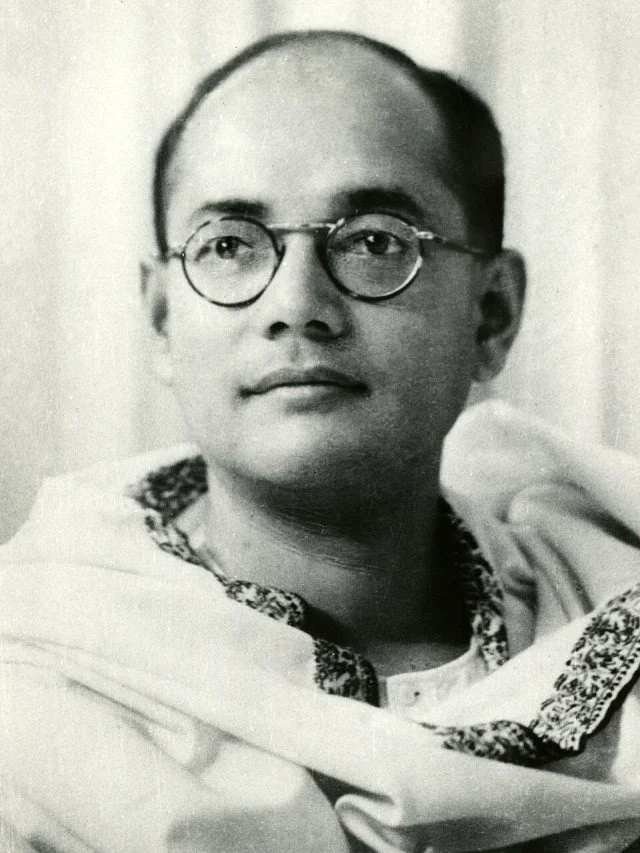
Twice elected President of the Indian National Congress, Subhas Chandra Bose broke with its leadership over the pace of the struggle, escaped British surveillance in 1941 and went on to lead the Indian National Army and the Provisional Government of Free India in South-East Asia.
Early life and background
Born in Cuttack into the family of a prominent lawyer, Bose studied at Presidency College and Scottish Church College in Calcutta and then at Cambridge. In 1920 he passed the Indian Civil Service examination, but resigned in 1921 to join the national movement, a decision that marked the rest of his life.
Historical context
Bose came of age as the national movement turned into a mass struggle. Working closely with Chittaranjan Das in Bengal, he was repeatedly imprisoned by the colonial government. By the late 1930s he was among the leaders demanding complete independence without compromise, and he argued that the outbreak of the Second World War should be used to press Britain to leave India.
Key achievements
He was elected Congress President at Haripura in 1938 and re-elected at Tripuri in 1939. After differences with the Congress leadership he resigned and formed the Forward Bloc. Placed under house arrest in Calcutta, he escaped in January 1941 and reached Germany, where he sought support for India’s freedom. In 1943 he travelled to South-East Asia, took command of the Indian National Army and proclaimed the Provisional Government of Free India in Singapore on 21 October 1943.
Important events and milestones
- 1921 Resigns from the Indian Civil Service to join the freedom movement.
- 1938 Elected President of the Indian National Congress at Haripura.
- January 1941 Escapes house arrest in Calcutta.
- 21 October 1943 Proclaims the Provisional Government of Free India (Azad Hind) in Singapore.
- 1944 INA units take part in the campaign on India’s north-eastern frontier, including Imphal and Kohima.
- 1945–46 The INA trials at the Red Fort provoke nationwide protest.
Awards and honours
The Government of India observes 23 January as Parakram Diwas. Numerous national institutions and places bear his name, and a statue of Netaji was unveiled at India Gate, New Delhi, in 2022.
His final days
Bose is reported to have died on 18 August 1945 from injuries sustained in an air crash at Taihoku (now Taipei). Two official inquiries (the Shah Nawaz Committee, 1956, and the Khosla Commission, 1970) accepted this account; a third, the Mukherjee Commission (2005), did not, and its conclusion was not accepted by the Government. The circumstances of his death therefore remain a subject of public debate.
Enduring legacy
Netaji’s insistence on complete independence, his attempt to build an army that cut across region, religion and caste, and the inclusion of a women’s regiment in the INA left a lasting mark. The public response to the INA trials is widely regarded by historians as one of the pressures that hastened the end of British rule.
References
- Encyclopaedia Britannica — Subhas Chandra Bose (opens in a new tab)
- Wikipedia — Subhas Chandra Bose (with cited sources) (opens in a new tab)
- Netaji Papers — declassified files, National Archives of India (opens in a new tab)
Portrait: Photograph · Unknown · Public domain · Source (opens in a new tab)
This account is compiled from the sources listed and is offered as a tribute, not as an official record. Corrections are welcome at connect@vedacloud.ai.