
Freedom Fighters
Mangal Pandey
1827 – 1857
The sepoy at Barrackpore whose act of defiance in March 1857 is remembered as a prelude to the great uprising.
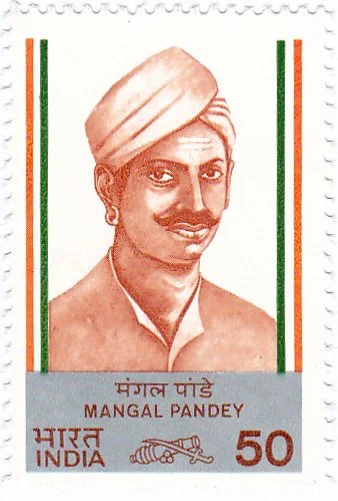
Mangal Pandey was a sepoy of the 34th Bengal Native Infantry. On 29 March 1857 at Barrackpore he attacked British officers and called on fellow soldiers to rise. He was court-martialled and hanged on 8 April 1857, weeks before the uprising began at Meerut.
Early life and background
Born in Nagwa in present-day Uttar Pradesh, Mangal Pandey enlisted in the Bengal Army of the East India Company in 1849.
Historical context
In early 1857, grievances among sepoys were heightened by rumours that the cartridges for the new Enfield rifle were greased with cow and pig fat, offensive to Hindu and Muslim soldiers alike.
Key achievements
On 29 March 1857 at Barrackpore, near Calcutta, Mangal Pandey confronted and attacked British officers of his regiment and urged his fellow sepoys to join him.
Important events and milestones
- 1849 Enlists in the Bengal Army.
- 29 March 1857 Act of defiance at Barrackpore.
- 8 April 1857 Hanged at Barrackpore.
- 10 May 1857 The uprising begins at Meerut.
Awards and honours
India Post issued a commemorative stamp in 1984. A memorial park at Barrackpore bears his name.
His sacrifice
Mangal Pandey was court-martialled and hanged at Barrackpore on 8 April 1857.
Enduring legacy
Historians continue to discuss his motives and the degree to which his action was planned, but his name became a symbol of the uprising that followed.
References
- Encyclopaedia Britannica — Mangal Pandey (opens in a new tab)
- Wikipedia — Mangal Pandey (with cited sources) (opens in a new tab)
Portrait: India Post commemorative stamp, 1984 · India Post, Government of India · GODL-India · Source (opens in a new tab) · Licence terms (opens in a new tab)
This account is compiled from the sources listed and is offered as a tribute, not as an official record. Corrections are welcome at connect@vedacloud.ai.