
Freedom Fighters
Rani Lakshmibai of Jhansi
c. 1828 – 1858
The queen of Jhansi who fought at the head of her forces in 1857 and fell in battle.
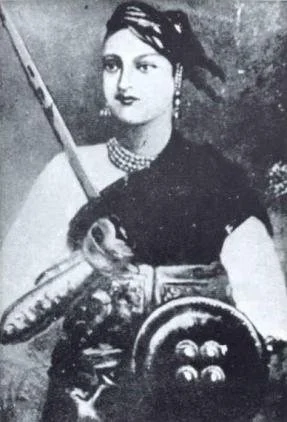
Rani Lakshmibai became a leading figure of the 1857 uprising after the East India Company annexed Jhansi under the Doctrine of Lapse. She defended Jhansi during its siege in 1858, fought on with Tatya Tope and others, and was killed in battle near Gwalior in June 1858.
Early life and background
Born Manikarnika Tambe in Varanasi, she is recorded as having grown up partly at the court of the Peshwa Baji Rao II at Bithoor, where she learned riding and the use of arms. She married Gangadhar Rao, the Maharaja of Jhansi, and took the name Lakshmibai.
Historical context
After the death of her husband in 1853, the East India Company under Lord Dalhousie refused to recognise their adopted son, Damodar Rao, as heir, and annexed Jhansi in 1854 under the Doctrine of Lapse. When the uprising of 1857 broke out, Lakshmibai took charge of the administration of Jhansi.
Key achievements
In March–April 1858 Company forces under Sir Hugh Rose besieged Jhansi. Lakshmibai led its defence; when the city fell she escaped to Kalpi and joined Tatya Tope and Rao Sahib. Together they took Gwalior in June 1858.
Important events and milestones
- 1854 Jhansi annexed by the East India Company.
- 1857 Takes charge of Jhansi during the uprising.
- March–April 1858 Leads the defence of Jhansi during the siege.
- June 1858 With Tatya Tope, takes control of Gwalior.
- 18 June 1858 Killed in battle at Kotah-ki-Serai near Gwalior.
Awards and honours
Statues and memorials across India honour her, including in Gwalior and Jhansi. The Rani of Jhansi Regiment of the Indian National Army was named after her.
Her sacrifice
Lakshmibai was killed in battle near Gwalior on 18 June 1858. Accounts of the exact circumstances differ.
Enduring legacy
Her life has been retold in poetry, song and scholarship. Subhadra Kumari Chauhan’s Hindi poem ‘Jhansi ki Rani’ made her story known to generations of schoolchildren.
References
- Encyclopaedia Britannica — Lakshmi Bai (opens in a new tab)
- Wikipedia — Rani of Jhansi (with cited sources) (opens in a new tab)
Portrait: Painted portrait (posthumous, 19th century) · Unknown · Public domain · Source (opens in a new tab)
This account is compiled from the sources listed and is offered as a tribute, not as an official record. Corrections are welcome at connect@vedacloud.ai.