
Freedom Fighters · Revolutionaries
Veer Vinayak Damodar Savarkar
1883 – 1966
Revolutionary organiser, writer and long-term political prisoner of the Cellular Jail.
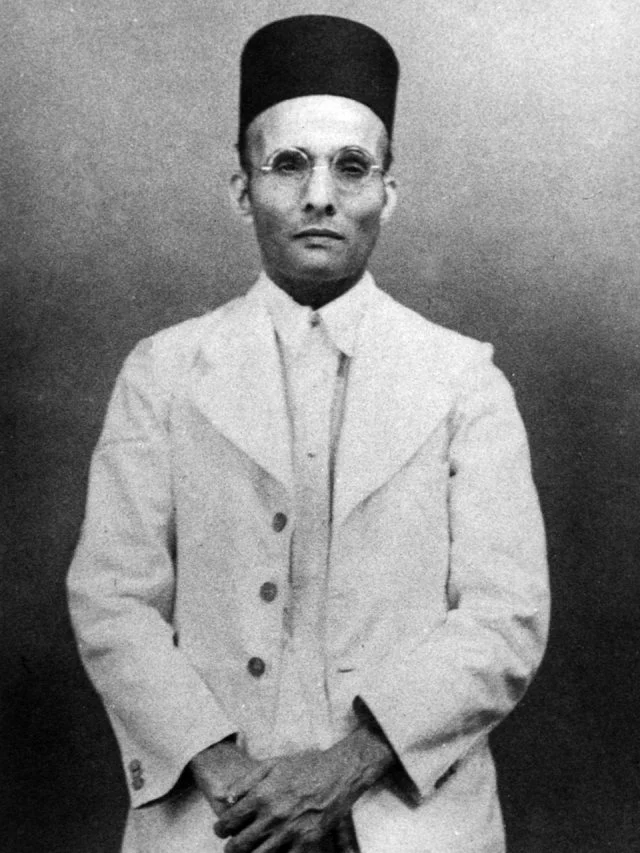
V. D. Savarkar founded the revolutionary society Abhinav Bharat, was active in the India House circle in London and wrote a history of 1857 as a war of independence that the colonial government banned. Arrested in 1910, he was transported to the Cellular Jail in the Andamans and remained imprisoned or under restriction until 1937.
Early life and background
Born in Bhagur near Nashik, Savarkar founded the Mitra Mela as a student, which later became Abhinav Bharat. He studied at Fergusson College, Pune, and went to London in 1906 to study law.
Historical context
In London he was associated with India House, a centre for Indian nationalists abroad. The early twentieth century saw revolutionary groups emerge in Maharashtra, Bengal and among Indians overseas.
Key achievements
Savarkar wrote ‘The Indian War of Independence of 1857’, which presented the uprising as a national war of independence; it was banned by the British before publication. Arrested in London in 1910 in connection with revolutionary activity, he attempted to escape at Marseilles while being taken to India by sea. He was sentenced to transportation for life and held in the Cellular Jail, Port Blair, from 1911.
Important events and milestones
- 1904 Abhinav Bharat formally established.
- 1906 Goes to London; associated with India House.
- 1909 His history of the 1857 uprising is banned.
- 1910 Arrested in London; escape attempt at Marseilles.
- 1911–1921 Imprisoned in the Cellular Jail, Andaman Islands.
- 1924–1937 Released from prison but confined to Ratnagiri district.
Awards and honours
Port Blair’s international airport is named Veer Savarkar International Airport. A plaque at the Cellular Jail National Memorial marks his imprisonment there.
Later life
After his restrictions were lifted in 1937 he became president of the Hindu Mahasabha. He was tried in the Mahatma Gandhi assassination case and acquitted in 1949. He died in Bombay on 26 February 1966 after voluntarily giving up food and medicine.
Enduring legacy
Savarkar’s revolutionary work and long imprisonment are widely honoured. His petitions for clemency from the Cellular Jail, his later political ideology and his role after release are the subject of continuing public and scholarly debate, and readers are encouraged to consult a range of historical sources.
References
- Encyclopaedia Britannica — Vinayak Damodar Savarkar (opens in a new tab)
- Wikipedia — Vinayak Damodar Savarkar (with cited sources) (opens in a new tab)
Portrait: Photograph · Unknown · Public domain · Source (opens in a new tab)
This account is compiled from the sources listed and is offered as a tribute, not as an official record. Corrections are welcome at connect@vedacloud.ai.